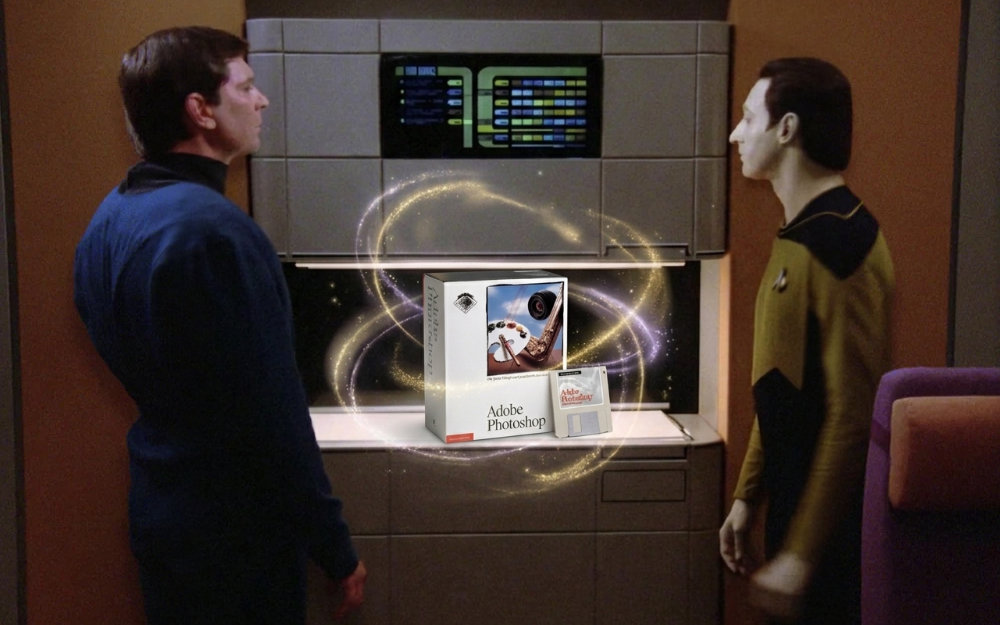
Jean-Luc Picard, the captain of the Starship Enterprise, famously orders his tea from a replicator with the words “Tea, Earl Grey, hot”, which then materializes right in front of him. Replicators play a relatively minor role in the Star Trek series, given that they can convert pure energy into physical matter. Were it not for Captain Picard’s insatiable thirst for tea, they’d hardly make an appearance.
But it’s not difficult to imagine that replicators would have an enormous effect on society. They could be used to create near-unlimited amounts of food, medicine, and even copies of themselves, finally ushering in the age of Fully Automated Luxury Communism1.
While we haven’t invented a matter replicator yet, we do have digital replicators. And as our lives have become more and more reliant on the digital world, some aspects of Fully Automated Luxury Communism have already arrived.
It’s been possible to make infinite copies of digital media, such as music, movies, literature, and software at zero cost for a while. Copyright holders have tried to prevent this with encryption and other annoying measures. But this doesn’t change the fact that we already live in a world of potential abundance where it’s technically possible to create unlimited copies of any song, movie, or book in existence – instantaneously and at no cost.
Recently, we’ve taken another step. In February 2026, Cloudflare announced that they had rebuilt the popular front-end framework Next.js using AI2. All Cloudflare engineers had to do was point Claude Code at Next.js’s years of documentation and test suites. Within a week, the AI essentially reimplemented Vercel’s Next.js framework from scratch3.
The writing is on the wall for all software companies that rely on their moat to charge ever-increasing fees. Vendors of accounting4, tax5, and photo editing6 software have forced loyal customers to upgrade to cloud products or monthly subscription plans over recent years. Features have been removed or require higher subscription tiers. But the shoe is now on the other foot. Two recent examples show that the barrier to replicating software and even entire business workflows has been lowered considerably.
A solo developer built a full double-entry accounting system, Tidwell, on Claude with a small MCP server7. It turns out the core application logic isn’t that hard and a QuickBooks subscription is not required.
Similarly, Deirdre Bosa, a journalist with no engineering background, opened Claude Code during a CNBC segment and described the project management tool she wanted in plain English. The resulting app was fully wired into her calendar and Gmail, and cost less than $20 in tokens8. Clearly, the seat-based pricing model that companies like Asana, Trello, and Linear relied on is on thin ice when an absolute novice can replicate their software for less than the cost of a two-month subscription.
It’s easy to underestimate the impact of this development by ignoring the fact that the digital world is in large part the “real” world. Most of our interactions are digital, whether they are communication, shopping, business, healthcare, or government-related.
Creating your own software and workflows is now within reach of an increasing number of people. If nothing else, this will pressure the most egregious rent-seekers and Enshittifiers9 to rethink their business models. At the same time, governments and corporations will come under pressure to open up access to data and APIs, which will further accelerate this transformation.
While AI isn’t able to reconstitute matter, it will bring us closer to a post-software-scarcity society. When producing new software is just as easy as saying “Earl Grey, hot”, who knows what people will come up with!
-
Fully Automated Luxury (Space) Communism is a tongue-in-cheek techno-utopian slogan referring to a society where automation, AI, and renewable energy advancements have pushed the cost of producing goods and services toward zero. Humanity would then enjoy abundance without scarcity-driven labor, but only if those productivity gains were distributed collectively rather than captured by capital owners. ↩︎
-
Cloudflare probably didn’t do this to avoid licensing costs (Next.js is open source under the MIT license), but to get full control of the software stack and the ability to optimize it for their needs. ↩︎
-
QuickBooks support forum thread: Price Increase 2025 ↩︎
-
Write-up of a Reddit developer’s Claude-built double-entry accounting system Tidwell (.NET console app + SQLite, with receipt OCR, double-entry enforcement, bank reconciliation, and QuickBooks import). Intuit has subsequently partnered with Anthropic to surface TurboTax, Credit Karma, QuickBooks, and Mailchimp inside Claude. ↩︎
-
Deirdre Bosa, CNBC – on-camera demonstration of vibe-coding a calendar/Gmail-integrated project management tool in roughly an hour for ~$20 in compute. ↩︎
-
Cory Doctorow coined the phrase Enshittification. ↩︎